





The World Federation Third Executive Council Meeting (ExCo) is taking place now click here to get a summary update of Day One!

Translate this page

18 July 2026 / 2. Safar 1448
UN Millennium Development Goals (MDGs): Goal 2 - The World Federation contributes to achieving universal primary education
Since 2010, The World Federation has been doing its part to ensure that the Millennium Development Goals (MDGs) formed by the United Nations are met by 2015. The Millennium Development Goals (MDGs) are the world's time-bound and quantified targets for addressing extreme poverty in its many dimensions including income poverty, hunger, disease, lack of adequate shelter, and exclusion-while promoting gender equality, education, and environmental sustainability. They are also basic human rights - the rights of each person on the planet to health, education, shelter, and security.
MDG GOAL 2: ACHIEVE UNIVERSAL PRIMARY EDUCATION
Low attendance in schools and access to education is directly linked to poverty. One of the objectives of the Millennium Development Goals is to achieve universal primary education. According to the MDG Report 2015:
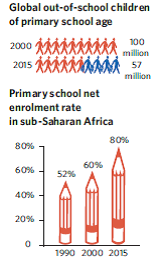
• The primary school net enrolment rate in the developing regions has reached 91% in 2015, up from 83% in 2000.
• The number of out-of-school children of primary school age worldwide has fallen by almost half, to an estimated 57 million in 2015, down from 100 million in 2000.
• Sub-Saharan Africa has had the best record of improvement in primary education of any region since the MDGs were established. The region achieved a 20 percentage point increase in the net enrolment rate from 2000 to 2015, compared to a gain of 8 percentage points between 1990 and 2000.
• The literacy rate among youth aged 15 to 24 has increased globally from 83% to 91% between 1990 and 2015. The gap between women and men has narrowed.
THE WORLD FEDERATION’S CONTRIBUTION
To help achieve universal primary education in our world, The World Federation’s Zainabiya Child Sponsorship Scheme provides children and youth access to education so that they can break out of the vicious cycle of poverty. ZCSS sponsors students who come from low income households and cannot afford school fees with the opportunity to go to school. The program caters for learners attending pre-school, primary school, secondary and post-secondary institutions.
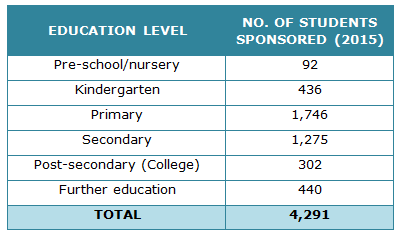
The World Federation has spent over 30 years educating students. Currently, the program is sponsoring 4,291 students across India, Pakistan, Bangladesh, Kenya and Tanzania where 2,431 students are male and 1,860 are female.
Related News

Across Kenya, scores of children drop out of school or do not attend regularly simply because of poor nutrition and calorie deficiencies that affect their ability to learn.
The inaugural Western Indian Ocean Studies workshop entitled 'Rahe Najat (The Path of Salvation): Religious and social dynamics amongst mercantile communities of the western Indian Ocean' was hosted by the department of religious studies from 12-13 November 2015 at the Florida International University in Miami.

